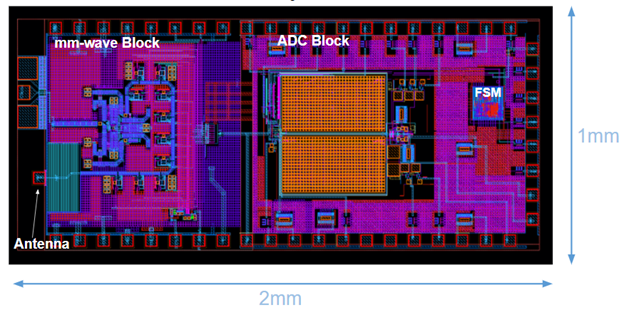
As any chip requires an interface between the analog and the digital domain, Data converters are an essential building block present in most of integrated circuits (ICs) today. In this thesis, a 10-bit ADC is designed and implemented, in 65 nm CMOS LPE, aimed at early detection of Melanoma, a dangerous form of skin cancer. The chip uses near-field imaging at 120 GHz, involving several blocks like an Oscillator, a tapped Transmission Line, Peak Detectors, an ADC and a Finite State Machine. In this work, the focus was on the design of a 10-bit SAR ADC which reads the analog output from a set of peak-detectors as a measure of Standing Wave Ratio (SWR) present on a transmission line. The application demands that the ADC will be able to accurately convert analog inputs from the range of 200 mV to 800 mV to a corresponding digital value at inputs as small as 1 mV. That demands the SAR ADC to have a resolution of 10-Bits. An issue that would arise is offset due to the differential pair at the input of the comparator. The magnitude of this offset could reach tens of millivolts. To accurately read values with a resolution of 1.2 mV with this level of offset, an offset cancellation technique based on auto-zero was implemented on-chip. It uses a novel dynamic latch comparator circuit while demanding no form of calibration. The ADC was designed to use only half power supply at 600 mV using counter-based SAR logic, and a pseudo-differential DAC to generate a full-scale output voltage from 0 to 1.2 Volts at 100 KHz. The SAR ADC was sent to Globalfoundries for fabrication. The ADC was extensively tested in simulations with post-parasitic extraction, high temperature, and corners after being integrated with the RF and digital blocks at the top level.

 Thaer Alafghani