
As the dimensions of neural implants are miniaturised to mm-scale, wireless powering becomes more challenging. Antenna sizes become
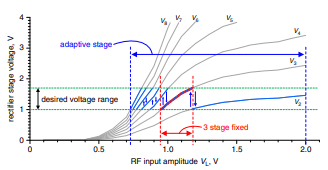
smaller, and so does the amplitudes of the received RF signal. More importantly, a meticulous effort is required when multiple implants are placed on the brain under a transmitter, as each implant has a different spatial position from the transmitter coil. In addition, RF power may fluctuate over time. These factors, both effects the coupling coefficient. In this case, rectifiers with a fixed number of stages are limited to a rather narrow operational voltage range, and cannot accommodate such variations. To address this, the authors propose an adaptive-stage rectifier that changes the number of connected stages by monitoring the final rectifier output voltage using two comparators and a digital block. By doing so, it can generate an output voltage within the targeted voltage range for a much wider RF input voltage range. The authors’ design and simulations in 180-nm CMOS SOI process show that the proposed rectifier is capable of keeping the output voltage within 1–1.7 V for an RF input range from 0.73 to 2 V, which is five times wider than that of conventional rectifiers with three fixed stages.
DOI: 10.1049/el.2019.2307
https://digital-library.theiet.org/content/journals/10.1049/el.2019.2307
 Thaer Alafghani